Early Sign of Alzheimer's Disease - Decreased Sense of Smell?
Written by Junji Takano
A decrease in sense of smell can be caused by various reasons, including aging and viral infection. But lately, studies have shown that decreased sense of smell can also be an early sign of Alzheimer's disease.
Research shows that the olfactory system, a sensory system used for smell, can get damaged due to Alzheimer's disease--specifically targeting the entorhinal cortex. It was found that the entorhinal cortex is associated in pairing odors with proper memories.
Fortunately, there is one easy way and also the cheapest way to diagnose early stage of Alzheimer's disease. We call this the 'peanut butter test'. Peanut butter is a readily available pure odorant that can only be detected by the olfactory system.
## Here's what you need to do:
1. Prepare one tablespoon of peanut butter and a metric ruler.
2. Have the patient sit down and have his or her eyes and mouth closed.
3. Have the patient block one of their nostrils and hold the ruler next the opened nostril.
4. Using the ruler, measure the distance at which the patient can detect the odor of peanut butter (when measuring, try to move the peanut butter up the ruler 1 cm at a time).
5. Record the measurement and wait for 1 minute and 30 seconds.
6. Repeat the same procedure on the other nostril.
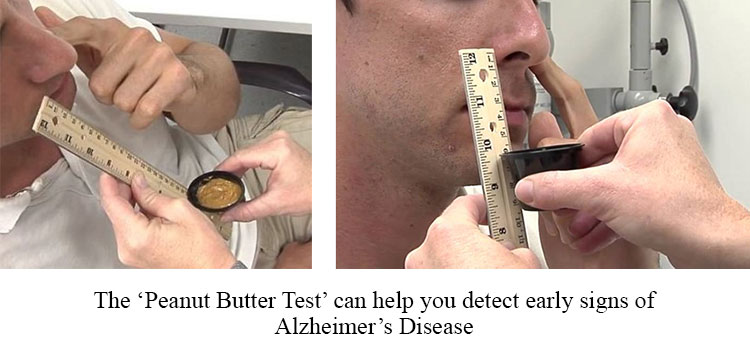
Surprisingly, experiments show that patients who have early stage of Alzheimer's disease demonstrated significant difference in detecting the peanut butter's smell between their left and right nostril. It's either the left nostril or right nostril's sense of smell is severely impaired and does not detect the peanut butter's odor until it is brought much closer to the nose.
In other words, one of their nostrils will smell it fine but not with their other nostril.
It's worth noting that other types of impairments like dementia did not show this much disparity, and is only applicable on Alzheimer's disease so far.
In conclusion, if the patient is not yet subjected to actual diagnosis, checking the patient's sense of smell by doing this peanut butter test can help you detect early signs of Alzheimer's disease.
Article author
About the Author
Junji Takano is a Japanese health researcher involved in investigating the cause of many dreadful diseases. In 1968, he invented the PYRO-ENERGEN electrostatic therapy machine, which effectively eradicates viral diseases, cancer, and diseases of unknown cause.
Subscribe to his free health newsletter at http://www.pyroenergen.com/newsletter.htm
Further reading
Further Reading
Article
Respiratory Infections and Pollution Effects - Causes, Symptoms & Prevention Tips
Abstract Respiratory infections are becoming increasingly common, and one of the major contributing factors is the rise in air pollution. Polluted air contains harmful particles, chemicals, and toxins that weaken the lungs and reduce the body’s natural defense mechanisms. As air quality worsens in cities, people of all age groups are experiencing more frequent coughing, breathing difficulties, allergies, and long-term respiratory diseases. How Pollution Increases Respirator
December 12, 2025
Article
Why Barometric Pressure Triggers Headaches - Causes, Symptoms & Prevention Tips
Many people notice that their headaches or migraines worsen when the weather changes. One of the most common culprits is barometric pressure, also known as atmospheric pressure. This pressure refers to the weight of the air around us, and even small shifts can affect sensitive individuals, often leading to headaches, sinus pressure, or migraines. What Happens When Barometric Pressure Drops? A drop in barometric pressure is common before storms, rainfall, or sudden weather c
November 22, 2025
Article
Research of Cell Membrane Nano Drug Delivery System and Its Application in Bionic Nanomedicine
Most of the old drugs are currently limited in their effectiveness because of poor pharmacokinetics, simple clearance by the body and cytotoxicity. Nanoparticle technology in particular, Nano drug delivery system is getting a lot of attention and application in medicine in the recent years. Since it is small (1100nm), targets well, and stays in the circulation long enough, NPs are a good candidate as a drug carrier, enabling an enhanced in vivo targeting capability and less n
January 21, 2025
Article
Research on Regulating cAMP Pathway to Chronic Obstructive Pulmonary Disease
The world's chronic disease, chronic obstructive pulmonary disease (COPD), is among the most incredibly morbid and mortal. A relatively common, preventable and curable condition, COPD most often reflects itself in chronic breathing problems and airway obstruction. Its cause is elusive and not well understood. The most important pathological processes involve oxidative stress, protease dysfunction, mitochondrial dysfunction and airway inflammation. Drug and oxygen treatment ar
January 21, 2025